
J.P. Morgan Personal Investing (Nutmeg) Lifetime ISA Review: My Real Returns Since 2018
Is leaving money in cash really “safe” — or are you quietly going backwards once inflation is taken into account?
That question is what pushed me into investing back in 2016. Savings rates were poor, inflation was doing its thing, and holding cash stopped feeling like the sensible option it once was.
And when you look at the average savings by age in the UK, it becomes clear how many people are relying on cash that isn’t really growing at all — which is exactly why inflation erosion matters.
One of the platforms I chose — and have stuck with ever since — is the J.P. Morgan Personal Investing Lifetime ISA (which used to be called Nutmeg).
In this review, I’ll show you:
- how my Lifetime ISA is actually invested
- how it’s performed over time
- the fees I’ve paid in the real world
- why I still use other platforms alongside it
- who this account is (and isn’t) right for
This isn’t theory or best-case projections. It’s my money, over several years, including mistakes.

J.P. Morgan Personal Investing review
Simple to open and easy to use, even if you’re new to investing. My Lifetime ISA has grown well over time and has beaten cash savings for long-term growth. Downsides are the fees on managed portfolios and the fact returns won’t be smooth year to year.

Pros
- Simple to get started
- Only £100 to open an account
- Easy-to-use app and website
- Solid long-term performance in my account
Cons
- Responsible portfolios aren’t cheap
- No cash LISA available
- Returns can go down as well as up
- Under-40s only to open a Lifetime ISA
 Reviewed by Household Money Saving
Why I opened a Lifetime ISA in the first place
Planning for retirement has always mattered to me. I joined the civil service young — partly for the pension — and while that’s worked out, I never liked relying on just one vehicle.
When Lifetime ISAs launched, they immediately appealed:
- a 25% government bonus
- flexibility compared to pensions
- the ability to invest rather than sit in cash
I opened my account in 2018, back when the platform was still called Nutmeg.
Why J.P. Morgan Personal Investing (formerly Nutmeg)?
At the time, there weren’t many Stocks & Shares LISA providers.
Nutmeg stood out because:
- setup was simple
- fees were reasonable for managed investing
- reviews were strong
- everything felt accessible, even without deep investing knowledge
Since being acquired, the platform is now J.P. Morgan Personal Investing, but the core experience hasn’t changed in any meaningful way.
Why not just use a pension?
Some people keep everything in one place. I don’t.
Pensions are powerful — especially for higher-rate taxpayers — but they’re also locked away. A Lifetime ISA gives me:
- flexibility
- earlier access (with penalties, yes — but still an option)
- diversification across different providers
I use a mix:
- this Lifetime ISA
- a Stocks & Shares ISA with Fidelity
- smaller, regular investing via Plum
If you’re weighing up options, I’ve also put together a guide to the best investment apps in the UK, which is useful if you want something simpler or more hands-off.
How I fund my Lifetime ISA
Most months, I invest £100 via direct debit.
Toward the end of the tax year, I top it up if I can. Some years I’ve maxed it out. Other years — not even close.
That inconsistency matters when looking at performance, which is why raw “headline returns” can be misleading.
Performance so far (and what the graph actually shows)
As of the latest update, my Lifetime ISA balance sits at £37,031.
Here’s how that breaks down:
• Total contributions: £26,484
• Total growth: £10,547
• Overall increase: +39.83%
That means a significant chunk of the balance is growth, not just money I’ve put in myself.
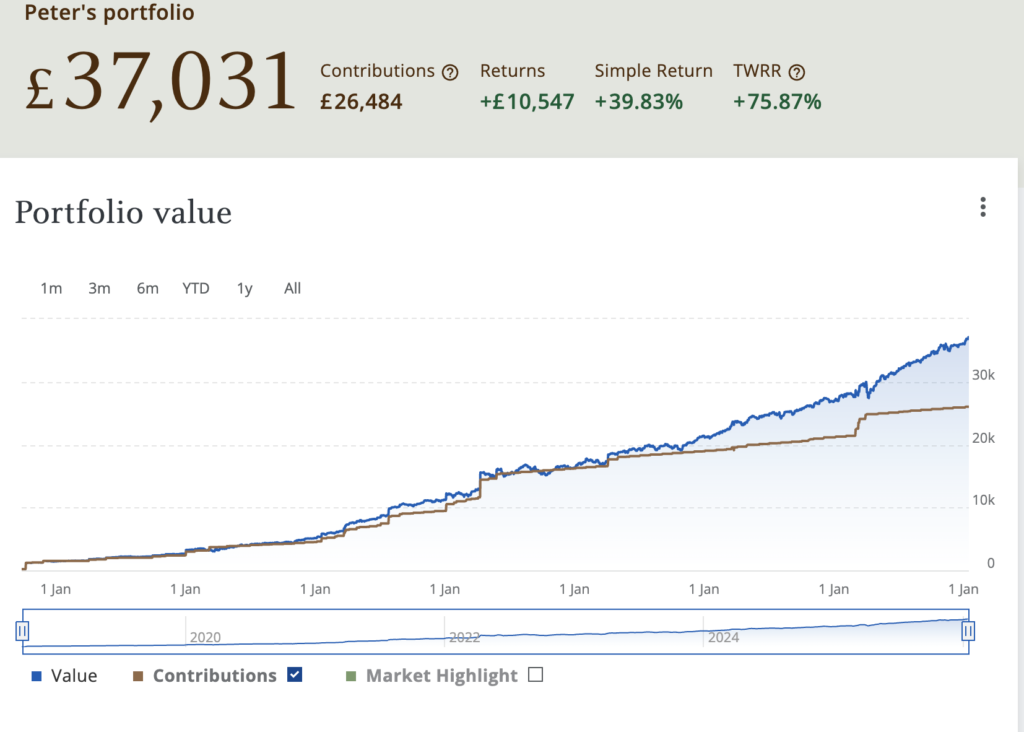
About the graph
The graph shows two key lines:
- Total contributions — what I’ve actually paid in
- Portfolio value — what the account is worth today
The widening gap between the two is the real story. That gap represents growth plus government bonuses, not just market luck.
Because most of my contributions were made in later years, the platform’s “simple return” figure massively understates real performance. When you look at contributions versus value, the outcome is far more meaningful.
Fees – what I’ve actually paid
Fees are often over-dramatised, but they matter.
My total fees paid so far are just under £400.
That’s not nothing — but:
- they’re taken from the balance, not my bank
- they include portfolio management
- performance has comfortably outweighed them
If you want rock-bottom fees, DIY investing elsewhere may suit you better. For hands-off investing, I think the pricing is fair.
Is J.P. Morgan Personal Investing safe?
The platform is regulated by the Financial Conduct Authority and covered by the FSCS.
As of December 2025, FSCS investment protection is:
- up to £120,000 per person, per firm
This covers platform failure — not market losses. If investments fall, that’s on the market, not the FSCS.
Looking ahead
J.P. Morgan’s projections suggest a six-figure pot by the time I hit my late 60s.
I don’t pay too much attention to forecasts. I plan to:
- stop contributing at 50 (when the bonus ends)
- access the money around 60
- treat this as one part of a wider plan
Final verdict – is it worth it?
For me, yes.
J.P. Morgan Personal Investing won’t excite you. It won’t gamify investing. And it won’t deliver smooth returns every year.
But over time, it has:
- beaten cash
- delivered solid, tax-free growth
- worked quietly in the background
Leaving this money in a cash ISA would have been the real risk.
If you’re a basic-rate taxpayer, under 40, and want a simple way to invest with a government bonus, this is still well worth considering — as long as you’re in it for the long term.
J.P. Morgan referral code
If you fancy opening an account, use the button below and you won’t pay any fees for the first six months.
Further reading
Why not take a look at other platforms that offer stocks and shares Lifetime ISAs?
Or take a look at why I invest more rather than pay off my mortgage.
And if you’re looking towards retirement, find out if £500,000 is enough to live on.
FAQ
Is J.P. Morgan Personal Investing the same as Nutmeg?
Yes. Nutmeg was rebranded as J.P. Morgan Personal Investing after being acquired by J.P. Morgan. Existing accounts, including Lifetime ISAs, continued unchanged.
How does the J.P. Morgan Personal Investing Lifetime ISA work?
You can invest up to £4,000 per tax year and receive a 25% government bonus. The money is invested in a managed portfolio rather than held as cash.
Is there a cash Lifetime ISA with J.P. Morgan Personal Investing?
No. J.P. Morgan Personal Investing only offers stocks and shares Lifetime ISAs, not cash LISAs. Your money will be invested and can go up or down.
What are the fees on a J.P. Morgan Personal Investing Lifetime ISA?
Fees depend on your portfolio type and size. Managed portfolios cost more than DIY investing, but fees are taken from your balance rather than charged separately.
Can you withdraw money from a Lifetime ISA early?
Yes, but withdrawals for anything other than a first home or after age 60 usually incur a government withdrawal charge, meaning you could get back less than you put in.
Is a Lifetime ISA better than a pension?
It depends. For basic-rate taxpayers, a Lifetime ISA can work well alongside a pension. Higher-rate taxpayers often benefit more from pension tax relief.
Is J.P. Morgan Personal Investing safe?
J.P. Morgan Personal Investing is regulated by the FCA and covered by the Financial Services Compensation Scheme (FSCS). As of December 2025, investment protection is up to £120,000 per person, per firm, excluding market losses.




Hi! I am looking at opening a S&S ISA but I am unsure whether to go with Vanguard, HL or Nutmeg. Do you have any recommendations? I am in my 20s and looking to invest for later in life.
Hi Seren. My preference is slightly toward Nutmeg, but that’s because I find it easy to use. But I certainly wouldn’t discount the others as they are all decent providers.
Thank you for sharing Peter. I’m in my 30s and have been working hard but don’t know how to invest even though I want to. You just break everything in simple language to understandable.
Hi Hana. Glad to help and it’s great that you’re looking to invest at such a young age.