
How to Spot a Fake Royal Mail Stamp (The One Test That Works)
Fake stamps are now so common that letters are being returned unpaid — even when the stamp was bought in the UK. But what’s the best way to tell if you have got hold of a fake?

The fastest way to tell if you’ve got a counterfeit stamp?
Run your finger over the barcode.
If it feels smooth, it’s almost certainly fake.
A genuine stamp has a slightly raised barcode that you can feel with your fingernail.
That single check will catch most counterfeit stamps in seconds.
I started looking into this after seeing multiple posts in a local Facebook group from people who’d had letters returned by Royal Mail due to counterfeit stamps. What surprised me most was that many of them had bought stamps from local shops, not dodgy websites.
Out of curiosity, I bought some fake stamps online to compare them side by side with genuine ones. It took minutes. They arrived quickly. And at first glance, they looked perfect.
They weren’t.
The fake stamps I bought
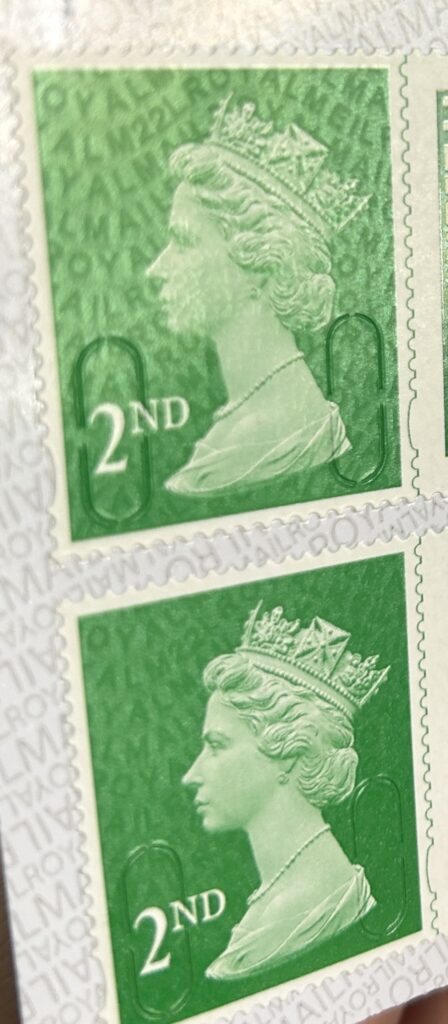
I bought a booklet of eight 2nd class stamps to compare against genuine ones. As you can see, they look completely convincing at first glance. The print is sharp, the barcode is present, and nothing jumps out as “wrong”.
This is exactly why so many people are getting caught out.


Quick check: how to spot a fake stamp in seconds
If you only remember one thing from this article, make it this:
Smooth barcode = fake
Raised barcode = genuine
Everything else below helps confirm it, but this single test is the most reliable and quickest way to tell.
What Royal Mail says to look for (and why it’s not enough)
Royal Mail lists several potential warning signs, including:
- Stamps sold below face value
- Missing or uneven security ovals
- Unusual colouring
- Uneven borders
- An unusually shiny surface
- Stamps attached to paper that feels like greaseproof paper
- Stamps sold in unusual quantities such as 55, 66 or 99
In reality, these signs are often subtle or inconsistent. On their own, they’re not much help.
Here’s what actually gives fake stamps away.
The real giveaways of a fake stamp
I worked for Border Force for over 20 years, much of that time on the front line dealing with forged documents. Forgers can replicate designs well. Texture, consistency, and microscopic detail are much harder to fake.
Placing counterfeit stamps next to genuine ones revealed several clear differences.
Colour inconsistency
The green on the fake stamp is slightly lighter and becomes darker from left to right. On the genuine stamp, the green is deeper and consistent across the whole design.
It’s subtle, but once you notice it, it’s obvious.

The border between the stamp and barcode
This needs magnification.
Look closely at the green semi-circles that separate the stamp from the barcode. On the fake stamp, the semi-circles are perfectly symmetrical. On the genuine stamp, they vary slightly.
That might seem counterintuitive, but those imperfections are deliberate security features — they’re difficult to reproduce accurately.

Fine image detail
This can’t be seen with the naked eye.
When magnified, the counterfeit stamp lacks fine detail. The Queen’s earring has less definition, and the lines in the hair are softer and less precise compared to the genuine stamp.
Up close, the difference is clear.

The booklet itself
This one surprised me.
The booklet containing the fake stamps actually feels better quality. The card is slightly thicker and stiffer than the genuine booklet.
However, the paper the stamps are attached to has a waxier feel and a faint brown or yellow tinge. The genuine booklet paper is a cleaner white/blue colour.
If the inside of the booklet looks off-colour, that’s a red flag.
Security features you can ignore
Some features are being copied so well that they’re no longer reliable indicators.
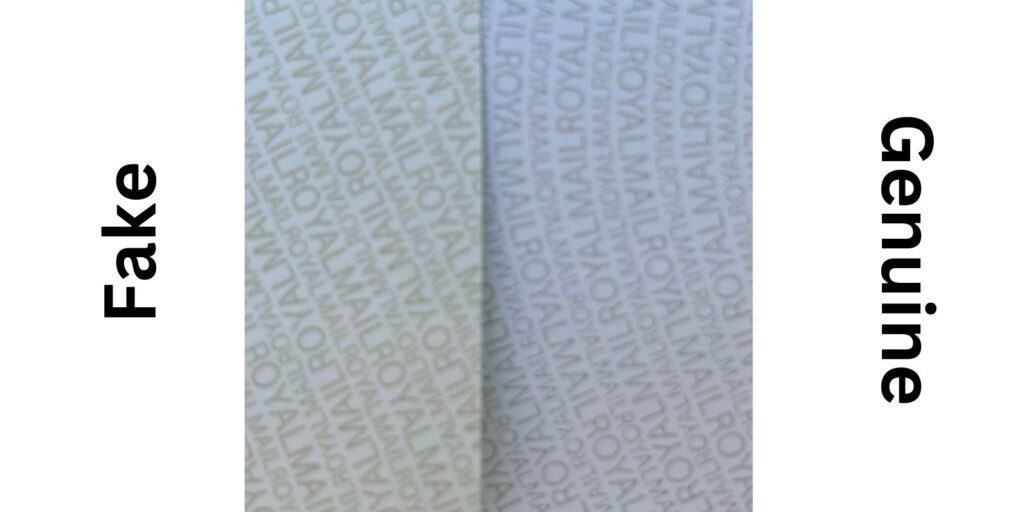
Reflective “Royal Mail” text
Holding a stamp up to the light reveals reflective “Royal Mail” text and a code. Counterfeiters are replicating this extremely well, so it’s not a good way to spot a fake.
UV strip
There is a UV-reactive strip down the centre of 2nd class stamps. However, this was present on both the genuine and counterfeit stamps I tested.
Again, not reliable on its own.

The test that actually works
The easiest and most reliable way to spot a fake stamp is by running your finger over the barcode.
Genuine stamps have a slightly raised barcode.
Counterfeit stamps feel completely smooth.
If it’s smooth, don’t use it.
Is it easy to spot a fake stamp?
By touch, yes.
By sight alone, not always.
If you only have one stamp and don’t compare it to a genuine one, it’s very easy to miss a counterfeit. That’s why so many people are being caught out.
If you’re unsure:
- Run your finger over the barcode
- Use your phone’s magnifier to check fine detail
- Look for colour inconsistency
- Check the booklet paper colour
What happens if you use a fake stamp?
Royal Mail’s automated sorting machines scan the barcode. Counterfeit stamps are increasingly being detected.
If a fake is flagged:
- The letter may be returned
- Or the recipient may be charged before delivery
Either way, someone loses money.
What to do if you’ve bought fake stamps
You can report stamp fraud — anonymously if you wish — via Royal Mail’s official reporting process.
If you bought the stamps from a shop or online seller, keep receipts and evidence. Some people report receiving refunds, others don’t. There’s no guarantee.
How to avoid buying fake stamps
I now only buy stamps from:
- Post Offices
- Supermarkets
I avoid:
- Online marketplaces such as Amazon and eBay
- Discounted stamp bundles
- Any seller offering prices below face value
Stamps have a fixed value. If they’re cheap, there’s usually a reason.
Final word
Fake stamps aren’t rare anymore — they’re widespread and convincing. But one simple check catches most of them.
If the barcode feels smooth, it’s fake.
If you’re interested in stamps, why not take a look at some of Britain’s rarest?
FAQ
How can you tell if a Royal Mail stamp is fake?
The quickest way is to run your finger over the barcode. Genuine Royal Mail stamps have a slightly raised barcode. Counterfeit stamps are smooth to the touch.
What happens if you use a fake stamp?
If a counterfeit stamp is detected, Royal Mail may return the letter or charge the recipient before delivery. Someone will usually end up paying the postage again.
Can Royal Mail detect fake stamps?
Yes. Royal Mail uses automated sorting machines that scan the barcode on modern stamps. Counterfeit stamps are increasingly being flagged during processing.
Will Royal Mail refund fake stamps?
Refunds aren’t guaranteed. Some people report getting refunds from sellers, while others don’t. Royal Mail does not usually refund counterfeit stamps bought from third parties.
Where do fake stamps usually come from?
Most counterfeit stamps are sold online or at discounted prices. Some have also been found in small local shops, often mixed in with genuine stock.
Are Amazon or eBay stamps safe to buy?
They can be risky. If stamps are sold below face value, there’s a strong chance they’re counterfeit. Stamps have a fixed value and genuine sellers don’t discount them.
Are UV strips and reflective text reliable security checks?
Not on their own. Counterfeiters are now replicating UV-reactive strips and reflective “Royal Mail” text very accurately, so these features are no longer reliable indicators.
Where should you buy stamps to avoid fakes?
The safest places are Post Offices and major supermarkets. These source stamps directly from Royal Mail and are far less likely to sell counterfeits.




Sorry, I don’t buy it.
Many of the so called ‘fake’ stamps come from Post Offices.
About 10% of stamps from the same book get through. I had to pay the excess on a letter recently due to the counterfeiting scam. The thing is it was a Stamped Addressed Envelope ~I had sent out. The letter I sent it in had the very next stamp in the book. It got there fine, the next morning.
In fact the previous 20 or so stamps from the book of 100 got their package to the intended destination without issue.
I haven’t checked the stamps against known good ones yet because, well how can I? These stamps were purchased from a Royal Mail outlet, so it is pot luck as to whether or not I’ll get ‘real’ ones or ‘fake’ ones, wherever they are purchased from.
The stamps have none of the indications of a forgery published on the Royal Mail website, all of the indications of a genuine stamp. Further more the colours are clear and even. The wording on the stamp carrier card, which is flimsy but laminated as expected is in a bluish grey, NOT yellow, NOT brown.
Royal Mail give no evidence that the stamp is counterfeit. They offer no recourse. They do not contact the police, Stamp counterfeiting is a crime. One that Royal Mail are now making a mint out of.
Call me a cynic, but its just a money making scam from the formerly great British mail carrier.
I for one will no longer use the Royal Mail for delivery of my mail or parcels.
Anyone interested in getting the question discussed in the commons, comment here.
Question: Do they flag reused stamps differently? Do they mark them as ‘Counterfeit’ or ‘Reused’?
The bar code is intended as a security measure to prevent reuse, apparently the over stamping is no good any more. It is a flawed design. If somebody buys good counterfeits, with duplicated barcodes. If the counterfeit is used, and not detected as such, then when the ‘real’ stamp with that bar code is used, it is the real stamp that is flagged as a counterfeit.
This would explain why consecutive stamps in a book are fine but some are then flagged.
Just a theory.
Have just been told a stamp I sent from a book of stamps is counterfeit,the qr code is raised but it does have other features of forgeries that you point out, have the forgers raised their game?
Thanks for letting me know, I’ll keep an eye out. It will be quite worrying if they manage to do this consistently as it will make them so much harder to spot.
Hello
Do you know what efforts Royal Mail take to identfiy and trace the sources of counterfeit stamps?
Kind regards
Tony Stafford
Hi Tony. Unfortunately, Royal Mail aren’t very forthcoming with information, so I’m not sure what they’re really doing to tackle the issue.