
Dehumidifier vs Tumble Dryer: Which Is Cheaper to Run?
If you’re deciding between a dehumidifier or tumble dryer, the real question is simple:
Which one actually costs less to run?
Drying clothes outside during a UK winter isn’t realistic. I used to rotate washing between the shower rail, spare room and radiators like some kind of laundry Tetris champion. It worked — until it didn’t.
The tumble dryer solved the space problem instantly.
But then came the electricity bill.
So I ran the numbers properly and compared dehumidifier vs tumble dryer cost using the latest electricity rates (around 25p per kWh).
Here’s what the maths says.
In most cases, a dehumidifier is cheaper.
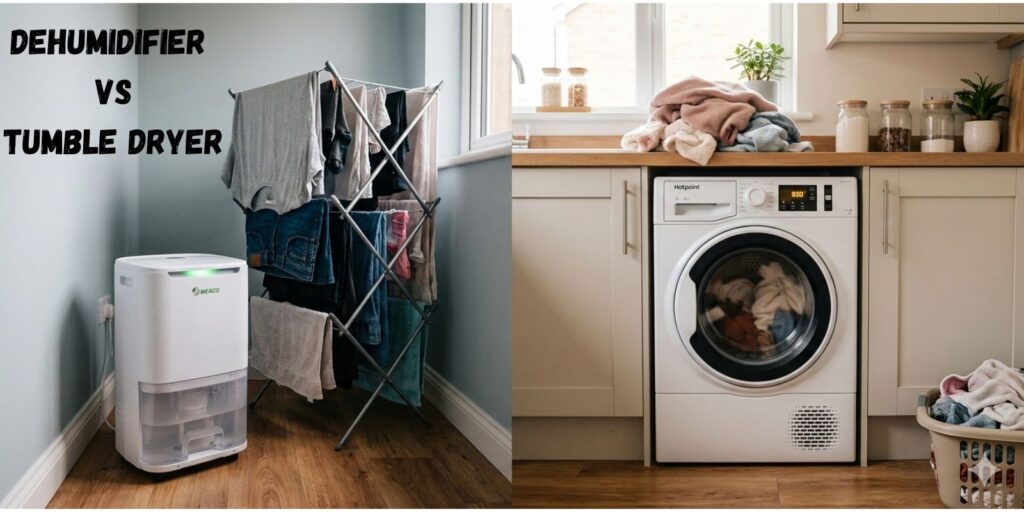
Quick Comparison: Dehumidifier vs Tumble Dryer
Feature | Dehumidifier | Tumble Dryer |
|---|---|---|
Drying time | 6–12 hours | 1.5–3 hours |
Typical wattage | 250W–650W | 2,000W–3,500W (800–1000W heat pump models) |
Cost per load | 42p–98p | 60p–£1.50+ |
Removes moisture from room | Yes | No |
Helps prevent mould | Yes | No |
Best for | Overnight drying | Fast turnaround |
If speed is your priority, the tumble dryer wins.
If cost and damp prevention matter more, the dehumidifier usually comes out ahead.
Scroll down for my calculator to work out your costs.
Is It Cheaper to Dry Clothes With a Dehumidifier?
Yes — in most UK households it is cheaper to dry clothes with a dehumidifier instead of a condenser or vented tumble dryer.
Even though a dehumidifier runs for longer, it uses far less power.
Let’s look at real numbers using 25p per kWh.
Cost of Running a Tumble Dryer
Heat Pump Dryer (Most Efficient)
Modern family-sized heat pump dryers typically draw around 800W–1000W during peak operation.
800W × 3 hours = 2.4 kWh
Cost per load: 60p
1000W × 3 hours = 3 kWh
Cost per load: 75p
These are far more efficient than older dryers — and much closer to dehumidifier costs.
Condenser Dryer
2500W × 2 hours = 5 kWh
Cost per load: £1.25
Vented Dryer
3000W × 2 hours = 6 kWh
Cost per load: £1.50
If you’re running a £1.25 dryer cycle four times per week, that’s:
£5 per week
£260 per year
That’s where the real difference starts to show.
Cost of Running a Dehumidifier (For Drying Clothes)
Assuming 6 hours of use:
280W × 6 hours = 1.68 kWh
Cost per use: 42p
440W × 6 hours = 2.64 kWh
Cost per use: 66p
650W × 6 hours = 3.9 kWh
Cost per use: 98p
Even a larger dehumidifier often costs less than a standard condenser or vented dryer.
If you switch from a £1.25 tumble dryer cycle to a 42p dehumidifier session and run four loads per week, you could save roughly:
£160–£200 per year
More if your dryer is older or higher wattage.
👉 Find out more about the cost of using a dehumidifier.
Annual Savings Calculator
👉 Annual Savings Calculator
Compare your tumble dryer and dehumidifier costs.
Heat Pump Tumble Dryer vs Dehumidifier
This is where the comparison gets tighter.
A modern 800W heat pump tumble dryer costs around 60p per load.
A 280W dehumidifier costs around 42p for a six-hour drying session.
That’s not a huge gap.
If you already own a heat pump model, the savings from switching to a dehumidifier are smaller.
If you’re running a condenser or vented dryer, the dehumidifier is significantly cheaper.
Does a Dehumidifier Dry Clothes Properly?
Yes — if you use it correctly.
Best setup:
• Small room
• Door closed
• Clothes spaced out
• Dehumidifier placed centrally
In my experience, clothes are usually dry overnight.
The added bonus? It actively removes moisture from the air, which reduces condensation and mould risk.
That’s something a tumble dryer doesn’t do — and poorly vented dryers can actually contribute to damp problems.
Heated Airer or Dehumidifier?
A heated clothes airer is another alternative.
A typical 200W airer running for 8 hours:
0.2 kW × 8 hours = 1.6 kWh
Cost: 40p
That’s cheap.
But heated airers don’t remove moisture from the air.
The “gold standard” winter setup in many UK homes is:
Heated airer + dehumidifier
The airer gently warms the clothes.
The dehumidifier pulls the moisture out of the room.
It’s efficient, cheap, and helps protect your home from damp.
So, Dehumidifier or Tumble Dryer?
If you want speed and convenience, choose a tumble dryer.
If you want lower running costs and protection against damp, a dehumidifier usually wins.
In the dehumidifier vs tumble dryer debate:
• Heat pump dryer = close call
• Condenser or vented dryer = dehumidifier is cheaper
For most households without a modern heat pump machine, the dehumidifier comes out ahead on cost.
Tips for getting the most out of your tumble dryer
If you decide using your tumble dryer is still worthwhile, here are a few tricks to reduce the running costs.
If you're washing multiple loads each day, then make sure that you load the tumble dryer immediately after one cycle has finished. This way, it will retain heat and use less energy.
Before loading the tumble dryer, use the spin cycle on your washing machine to get rid of excess water.
If your dryer has a low heat setting, use it. The drying will take longer but will use far less electricity.
Tumble dryer balls are a cheap gadget that will help separate your clothes once in the machine. This should help them to dry faster and will reduce the running time of your tumble dryer.
FAQ
If you want to save even more money, why not take a look at some other energy-saving devices?
FAQs
Is a dehumidifier cheaper than a tumble dryer?
Yes, in most cases. Standard condenser and vented dryers usually cost more per load than a dehumidifier.
Is it cheaper to dry clothes with a dehumidifier?
Yes — especially if you’re replacing a high-wattage dryer.
How much electricity does a dehumidifier use compared to a tumble dryer?
Most dehumidifiers use 250–650W. Many tumble dryers use 2,000–3,000W (or 800–1000W for heat pump models).
Can a dehumidifier replace a tumble dryer?
For overnight drying and smaller households, absolutely.
What is the cheapest way to dry clothes indoors?
Heated airer + dehumidifier is usually the most cost-effective setup.


